
You want to crack the NDA exam. You want to do it fast. But you have no clue how many hours you should study daily. Some say 4 hours works fine. Others claim you need 10 plus hours. The confusion is real.
Here is the truth. The number of study hours matters less than how you use those hours. Smart preparation beats long preparation every single time.
This blog gives you a practical, no-nonsense approach to planning your NDA study hours. Follow it. Stick to it. Watch the results follow.
Understanding the NDA Exam Structure First
Before deciding on study hours, understand what you face. The NDA written exam has two papers.
Paper 1 covers Mathematics worth 300 marks. Paper 2 covers the General Ability Test worth 600 marks. Total marks equal 900.
The GAT paper includes English, Physics, Chemistry, Biology, History, Geography, and Current Affairs. Mathematics demands strong problem-solving skills. GAT requires broad knowledge across subjects.
Your study hours must reflect this structure. Many students spend equal time on all subjects. This approach fails. Allocate time based on paper weightage and your personal weak areas.
How Many Hours Should You Study Daily for NDA
|
Time Slot |
Activity / Subject |
Duration |
Key Focus |
|
6:30 AM - 7:00 AM |
Wake Up & Morning Routine (Physical Fitness) |
30 mins |
Meditation, stretching, and breakfast preparation |
|
7:00 AM - 7:30 AM |
Light Exercise (Physical Fitness) |
30 mins |
Running, jogging, or yoga |
|
7:30 AM - 9:30 AM |
Mathematics Study (Maths) |
2 hours |
Concept building, formula learning, 30-40 practice questions |
|
9:30 AM - 10:00 AM |
Short Break (Rest) |
30 mins |
Light snack, hydration, mental refresh |
|
10:00 AM - 10:30 AM |
Vocabulary Building (English) |
30 mins |
Learn 10 new words from past papers |
|
10:30 AM - 1:00 PM |
English + GAT Study (English & GK) |
2.5 hours |
Grammar, reading comprehension, basic GK concepts |
|
1:00 PM - 3:00 PM |
Lunch & Rest (Break) |
2 hours |
Proper meal, family time, power nap (20-30 mins) |
|
3:00 PM - 5:00 PM |
Science & GK Study (Science & GK) |
2 hours |
Physics/Chemistry/Biology/History (alternating), 30 MCQs |
|
5:00 PM - 5:45 PM |
Evening Walk/Exercise (Physical Fitness) |
45 mins |
Light exercise, fresh air, mental break |
|
5:45 PM - 8:00 PM |
Family Time & Dinner (Personal Time) |
2.25 hours |
Dinner, family interaction, light hobby |
|
8:00 PM - 8:45 PM |
Daily Revision (Mixed Subjects) |
45 mins |
Revise what you studied today (flashcards, mind maps) |
|
8:45 PM - 9:30 PM |
Current Affairs |
45 mins |
News reading, defense updates, important events |
Let me give you a straight answer. Study 6 to 8 focused hours daily for NDA preparation.
This recommendation comes with conditions. Those 6 to 8 hours must involve active studying. Scrolling through notes while checking your phone does not count. Solving problems with full concentration counts.
Here is a breakdown based on your preparation timeline.
If You Have 6 Months or More
Study 5 to 6 hours daily. Divide time between Mathematics and GAT equally. Use weekends for revision and mock tests. This pace prevents burnout and allows deep understanding.
If You Have 3 to 6 Months
Increase to 6 to 8 hours daily. Give Mathematics 3 hours. Give GAT 3 to 4 hours. Reserve 1 hour for previous year papers. Maintain this schedule consistently.
If You Have Less Than 3 Months
Study 8 to 10 hours daily. Focus heavily on high weightage topics. Skip low yield areas ruthlessly. Attempt at least one full mock test weekly.
The Best Daily Study Schedule for NDA Aspirants

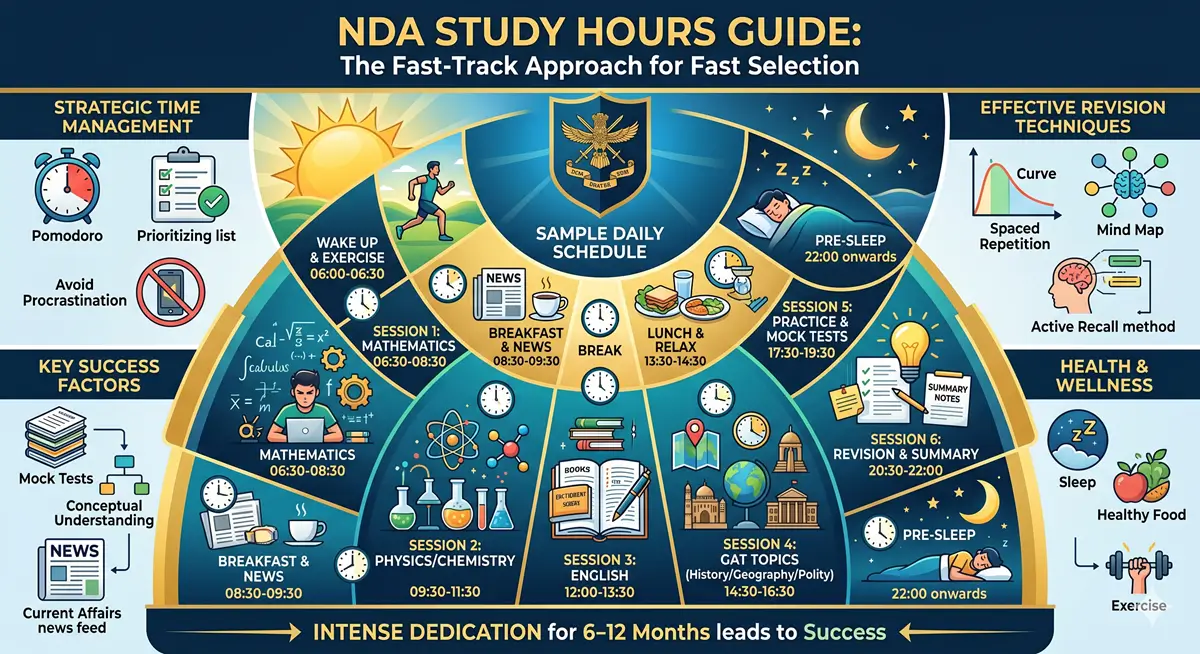
Theory means nothing without a practical schedule. Here is a sample timetable that works.
Morning Session from 6 AM to 9 AM
Start with Mathematics. Your mind stays fresh in the morning. Tackle complex problems during this window. Solve at least 20 to 30 problems daily from different chapters.
Mid Morning from 9 30 AM to 12 30 PM
Switch to Physics and Chemistry. These subjects need conceptual clarity. Read theory first. Solve numerical problems after. Cover one topic completely before moving ahead.
Afternoon from 2 PM to 4 PM
Study History, Geography, and General Science. Make short notes while reading. These notes save time during revision. Focus on facts, dates, and important events.
Evening from 5 PM to 7 PM
Work on English and Current Affairs. Read newspapers for 30 minutes. Practice English grammar and comprehension. Vocabulary building should happen during this slot.
Night from 8 PM to 10 PM
Revise everything you studied during the day. Solve 10 to 15 previous year questions. Make a list of doubts for the next day.
Subject Wise Time Allocation Strategy
Your daily hours need proper distribution across subjects. Here is a percentage based approach.
Mathematics deserves 35 to 40 percent of your total study time. This subject carries 300 marks. Many students fear math and avoid it. Bad move. Consistent daily practice makes math scoring.
English needs 15 percent of your time. Focus on grammar rules, vocabulary, and reading comprehension. Practice spotting errors daily.
Physics and Chemistry together need 20 percent. Learn formulas thoroughly. Solve numerical problems regularly.
History, Geography, and Polity need 15 percent. Create timeline charts for history. Study maps for geography. Know the Constitution basics.
Current Affairs need 10 percent. Read daily news for 30 minutes. Make weekly summaries. Focus on defense related news.
Why Quality Beats Quantity Every Time
Studying 12 hours with distractions produces worse results than 6 focused hours. Your brain absorbs information best during concentrated sessions.
Use the Pomodoro Technique. Study for 50 minutes. Take a 10 minute break. Repeat. This method keeps your mind sharp throughout the day.
Avoid these common mistakes.
Multitasking during study sessions kills retention. Keep your phone in another room. Study one subject at a time. Take proper breaks between sessions.
Passive reading wastes time. Active recall works better. Close the book. Try explaining the concept aloud. Test yourself constantly.
Skipping revision leads to forgetting. Reserve 20 percent of daily study time for revision. What you learned yesterday needs reinforcement today.
Weekly Study Plan That Gets Results
Your weekly schedule needs structure. Here is a framework.
Monday through Friday should follow the daily schedule mentioned above. Keep these days for new topics and practice.
Saturday works best for full length mock tests. Attempt one complete paper under exam conditions. Time yourself strictly. Analyze mistakes immediately after.
Sunday should focus on revision and rest. Review the entire week. Clear pending doubts. Give your brain recovery time.
The Mistakes That Waste Your Study Hours
Many NDA aspirants study long hours but fail selection. They make these errors.
Studying without a plan leads to random preparation. Create weekly targets. Track daily progress. Adjust plans based on performance.
Ignoring weak subjects feels comfortable but hurts scores. The subject you avoid often determines your rank. Face weak areas head on.
Relying only on one book limits understanding. Use NCERT for basics. Add reference books for practice. Previous year papers remain essential.
Skipping physical fitness preparation wastes effort. The NDA selection includes SSB interview and physical tests. Study hours must leave time for exercise.
How to Track Your Progress Effectively
Track your study hours and quality. Use a simple notebook or app.
Record subjects covered daily. Note topics that need more work. Write down problem areas.
Weekly self assessment helps adjustment. Ask yourself these questions. Did you complete planned topics. Which subjects need more time. Where do you struggle most.
Mock test scores reveal reality. Compare scores over weeks. Rising scores indicate right direction. Flat scores suggest strategy changes.
The Final Push Before Exam Day
In the last 30 days, change your approach.
Reduce new learning. Increase revision time. Solve two mock tests weekly. Focus on previous year paper patterns.
Sleep matters more now. Eight hours of sleep before exams beats last minute cramming. A rested brain performs better.
Light study on the final day works best. Quick revision of formulas and facts. No new topics. Early dinner and early sleep.
What Separates Selected Candidates from Others
Selected NDA candidates share common habits.
Consistency over intensity. They study daily without fail. They avoid marathon sessions followed by lazy days.
Strategic preparation over random effort. They know the syllabus deeply. They prioritize high scoring areas.
Mental toughness over natural talent. They face setbacks and continue. They learn from mock test failures.
Your study hours matter. Your study strategy matters more. Your consistency matters most.
Start today. Follow this guide. Adjust based on your results. The uniform you dream of wearing awaits your effort.
Leave A Comment